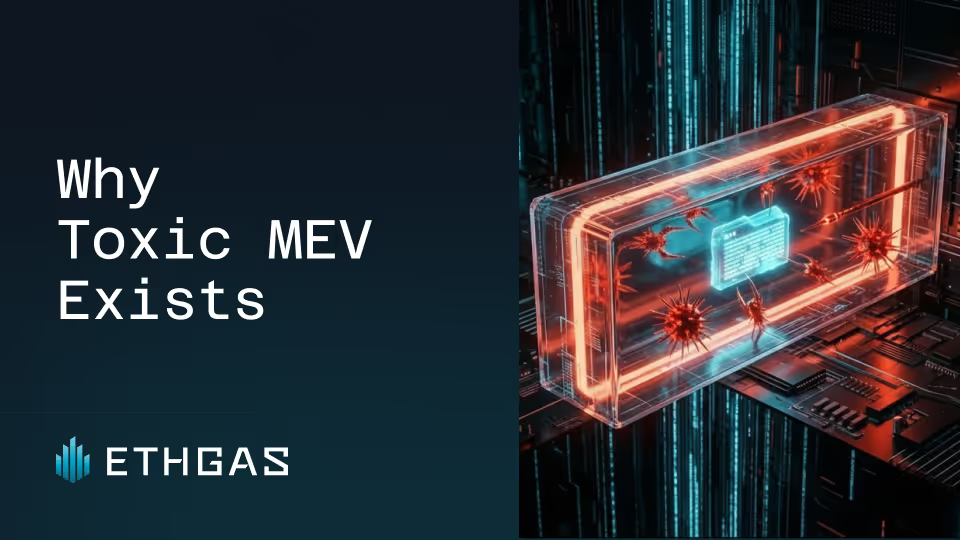
Why Toxic MEV Exists
Toxic MEV isn't just bad behavior—it’s a structural consequence of Ethereum’s 12-second block delay, which creates an "arbitrage window" where your trades are exposed before they settle. ETHGas closes this gap by enabling Realtime Ethereum, resolving transactions in milliseconds to collapse the time between intention and execution. By shrinking this window, we remove the economic basis for predatory arbitrage and make the L1 safe for users again.
If you have traded on Ethereum for any length of time, you already know how the experience feels, even if you have never put language to it. You submit a transaction, watch the price move, and then wait. During that wait, you are not really in control. Something might change. Often, something does.
Over time, most users stop thinking of this as a flaw. You widen slippage a little more than feels reasonable. You pay more for gas than you think you should have to. You retry transactions without fully understanding why they failed the first time. None of this feels good, but it starts to feel normal.
This normalization hides the real issue: what users experience as inconvenience or unpredictability is actually a structural consequence of how Ethereum executes transactions. And what we call “toxic MEV” is not an accident of bad behavior or adversarial actors — it is the natural outcome of that structure.
Execution on Ethereum Leaves a Gap
Ethereum executes transactions in blocks, roughly every twelve seconds. When a user submits a transaction, it does not execute immediately. It enters the public mempool, where it waits until a block is built and finalized. During that time, the transaction is visible to everyone, but unresolved.
During those twelve seconds, block builders and searchers simulate outcomes. They observe how prices would move if the transaction executes. They consider how other pending transactions interact with it. They decide whether reordering transactions, inserting new ones, or reacting to price changes could be profitable.
None of this is surprising. It is exactly what rational actors do when they are given time, information, and the ability to act before outcomes are locked in.
The key point is that Ethereum’s execution model creates a window during which intentions are exposed but outcomes are not yet fixed. That window is where MEV lives.
The Arbitrage Window Is the Real Problem
MEV is often discussed as if it were a category of strategies or a class of actors. In reality, it is better understood as a condition. MEV exists when there is enough time between intention and execution for arbitrage to form.
In traditional markets, that window is extremely small. Orders are matched continuously or near-continuously. If you submit a trade, it either executes immediately at the stated price or it does not execute at all. There is very little opportunity for third parties to observe your intent, react to it, and change the outcome before it settles.
On Ethereum, the opposite is true. Twelve seconds is a long time. It is long enough for simulations to run, strategies to coordinate, and transactions to propagate across networks. As long as that time exists at that scale, arbitrage will form, and extraction will follow.
This is why MEV is so persistent. It is not a bug that can be patched or a behavior that can be discouraged. It is a structural feature of delayed execution.
What Happens When the Window Shrinks
Realtime Ethereum approaches the problem from a different angle. Instead of trying to control who can extract value, it changes when value can be extracted by changing how execution resolves.
Rather than resolving execution only at the end of a twelve-second block, execution resolves continuously in sub-block intervals measured in milliseconds. State updates happen incrementally. Outcomes are determined before meaningful arbitrage can form.
This does not make Ethereum magically fair, nor does it eliminate all forms of MEV. What it does is remove the most damaging category: MEV that depends on delayed resolution.
When execution resolves faster than information can propagate, many extraction strategies simply stop working. The arbitrage window becomes too small to exploit. The cost of reacting exceeds the value that can be captured.
This changes behavior across the system. Searchers do not disappear, but their role shifts. Users no longer need to defensively widen slippage or overpay for gas. Execution becomes something you can reason about rather than something you hope works out.
The effects of shrinking the arbitrage window extend beyond swaps and trading interfaces. Wallets can treat confirmation as immediate rather than tentative. Applications can reason about state transitions without building in defensive margins. Validators participate in a system where value comes from providing reliable execution rather than opportunistic ordering.
Most importantly, it expands what Ethereum L1 can support. Applications that require fast feedback loops no longer need to move off-chain or to L2s simply to escape execution uncertainty. They can exist on mainnet without sacrificing user experience.
Closing Thoughts
Toxic MEV persists because Ethereum’s execution model leaves a long gap between intention and resolution. During that gap, transactions are exposed, outcomes are uncertain, and arbitrage has time to form. As long as execution remains delayed at the block level, value will continue to flow toward those best positioned to exploit that delay.
ETHGas approaches this problem at its root. By restructuring how blockspace is consumed and executed, it enables Ethereum blocks to resolve continuously rather than all at once. Execution is no longer deferred to the end of a twelve-second interval, but resolved incrementally in sub-block timeframes.
That change collapses the arbitrage window. When execution resolves faster than information can propagate, the economic basis for toxic MEV weakens. Searchers do not need to be constrained or excluded; the opportunity set itself shrinks. What remains is value derived from providing execution guarantees, not from exploiting uncertainty.
Let’s go back to the L1.