Realtime Ethereum in DeFi Lending: Speeding Through the Latency Risk
Imagine bringing your watch to a pawn shop for a loan. There's a long line ahead of you. You wait. And wait. The market is moving outside, by the time you reach the counter, the clerk looks at your watch and says: "this isn't worth what it was when you walked in. Deal's off." This is what happens onchain everyday due to block latency.
Lending is one of the areas where the limitations of block latency are most visible. Today, the majority of lending protocols still operate on 12 second block confirmations, while the reality of any financial markets is that they move in milliseconds. When liquidations depend on whether a transaction lands in time, risk stops being a function of pricing or collateral ratios and becomes a function of luck.
Realtime Ethereum changes this dynamic. By compressing the delay between transaction submission and execution, it transforms how lending protocols manage collateral, liquidations, and systemic risk.
The Hidden Latency Risk
Lending protocols rely on liquidations to remain solvent. When a borrower’s collateral falls below the required threshold, the protocol must close the position and sell the collateral to repay the loan. In theory, this mechanism should be a simple way to keep lending markets safe, but in practice, there is the added complexity of a race.
The typical liquidation sequence begins with a price update from an oracle. Once the price update pushes a position below the liquidation threshold, bots detect the opportunity and immediately submit liquidation transactions. Those transactions enter the public mempool where they compete with other transactions for inclusion in the next block and the outcome depends on which transaction lands first.
During this window the market continues moving, however. So while liquidation bots compete in gas auctions, some transactions fail or arrive too late. Others are reordered by block builders.
The result is that liquidation outcomes are not deterministic. They depend on mempool competition and transaction ordering rather than purely on risk parameters.
When Liquidations Fail
When liquidations fail to execute in time, lending protocols accumulate bad debt.
This has happened repeatedly across DeFi during periods of volatility. One of the most well known examples occurred on Aave V2 during the market turbulence of November 2022. A single position generated roughly $1.7 million in unrecoverable debt after hundreds of liquidation attempts failed to settle quickly enough.
More than 380 transactions were involved in the attempt to liquidate the position. The process took nearly 50 minutes to resolve while the oracle lagged behind market prices.
The failure was a consequence of execution latency. The infrastructure that DeFi lending relies on could not react to market conditions quickly enough. This type of failure is not unique to one protocol. Any lending market operating on the same block-based infrastructure faces the same constraints.
How Realtime Ethereum Changes Lending Infrastructure
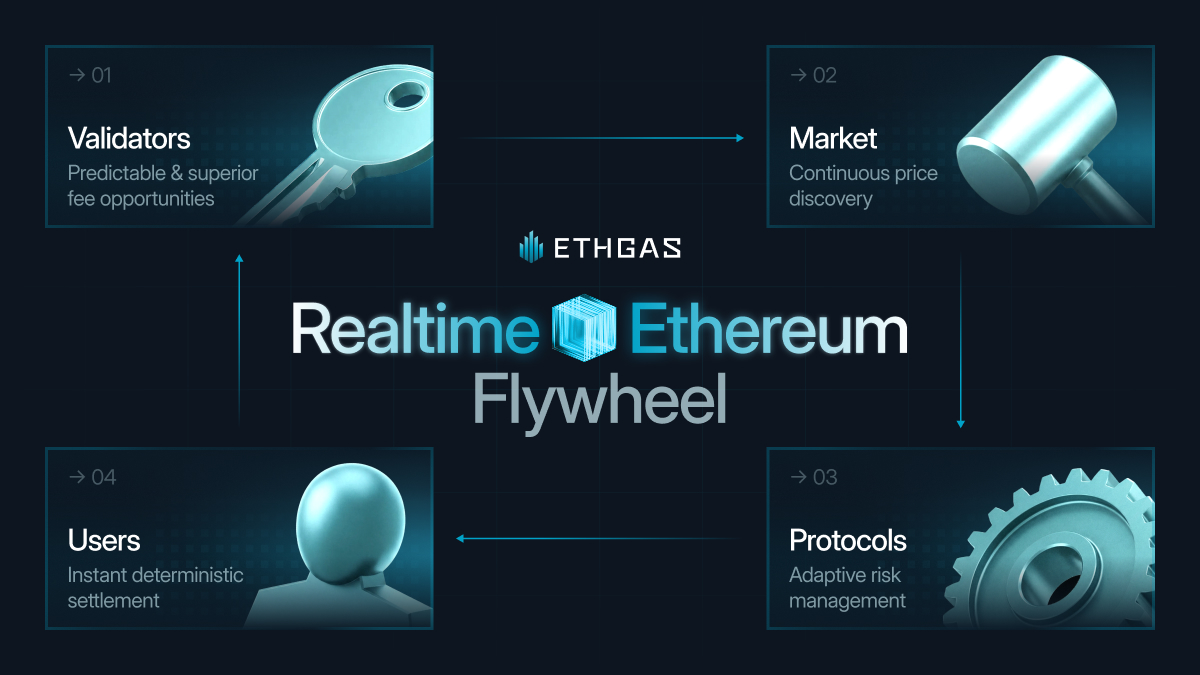
Realtime Ethereum replaces block based coordination with continuous execution. Instead of waiting for block confirmations, ETHGas broadcasts updates to the chain state every 50 to 100 milliseconds. Liquidation engines can observe positions going underwater as it happens rather than relying on delayed block snapshots.
Transactions are routed through ETHGas execution channels where ordering and pricing occur before block inclusion. This allows transactions to be executed with predictable timing rather than relying on a mempool race.
In practical terms, this means liquidation bots can react to live chain state and receive near-instant feedback on whether their transaction was included. Execution becomes reliable instead of probabilistic.
The New Economy for Lending Protocols
When execution becomes predictable, protocol design changes. Faster liquidations allow protocols to tighten collateral ratios because positions can be closed immediately when risk thresholds are breached. Liquidation engines no longer depend on large time windows to compete for block inclusion.
Risk models also become more precise. Instead of assuming that some liquidations will fail, protocols can design systems around reliable execution under volatile market conditions.
Insurance funds can be smaller because fewer losses occur due to delayed liquidations. Collateral can be used more efficiently because safety margins no longer need to compensate for infrastructure delays. The entire lending market becomes more capital efficient.
A Foundation for the Next Generation of Lending Protocols
The next generation of lending protocols will not win solely by offering slightly better interest rates. They will win by building on infrastructure that allows predictable execution under stress.
Realtime Ethereum upgrades the risk model of DeFi lending by eliminating the uncertainty created by block latency. Risk once again becomes a function of pricing and collateral rather than transaction timing. This shift lays the foundation for a new generation of lending markets that can operate at the speed of global finance.
Faster and safer lending is now possible onchain.
Realtime Ethereum is live on mainnet. Jump into the docs to learn more and follow ETHGas on X to stay in the loop.