Realtime Ethereum in Wallets: Closing the Anxiety Gap
Every user knows what it’s like to use a wallet app and experience those 12 seconds in between sending a transaction and receiving a final confirmation. Failed or abandoned transactions are not uncommon in today’s paradigm. Neither are the effects of MEV.
The ideal wallet experience would be akin to what users expect from traditional finance apps, but with all the security and decentralization that exists only in blockchain apps. In this post we explore how Realtime Ethereum enables this experience and avoids revenue leak.
The Anxiety Gap
Here’s the main issue with today’s wallet UX:
In 12 seconds, a swap price can slip 2%.
In 12 seconds, a $100M liquidation can cascade.
In 12 seconds, a "fat finger" swap can be sandwiched by a bot.
It’s not fundamentally a problem with the wallet app itself, however. Ethereum transactions still execute on block intervals where users submit transactions to a public mempool and wait for block inclusion. During this window, markets move, bots react, and users lose their edge. So, in order to ensure the transaction goes through, users set a slippage tolerance.
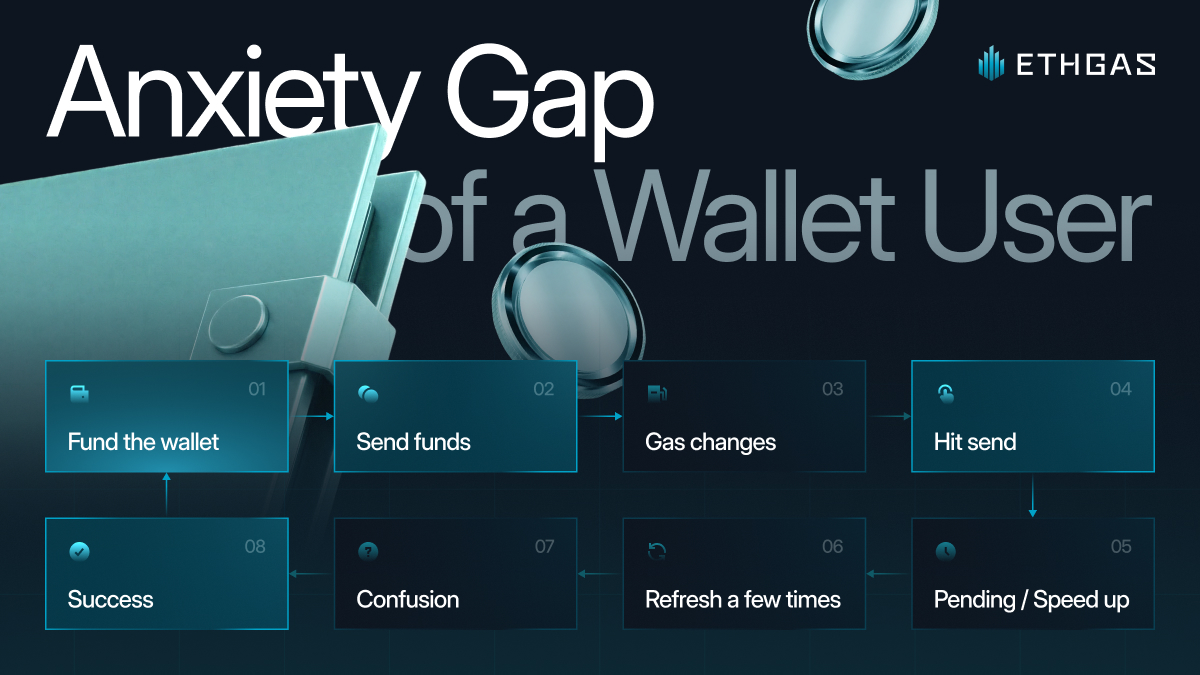
Here's what the average user transaction looks like in practice:
The user sets 1% slippage tolerance just to make the transaction go through. That means that on a $1,000 swap, $10 is lost to slippage, for example. Additionally, the user gets MEV exposure because bots have 12 seconds to see their transaction and get ahead of the user’s trade. They also run the risk of being affected by a sudden price change, executing on a misquoted transaction due to oracle latency, or running out of liquidity in the target market.
All of this happens while the wallet UI simply says pending. During this time, users must now monitor confirmations on Etherscan, bump gas, understand reverts and sometimes even replace the transaction altogether because some transactions fail altogether. In effect, every time a user executes a transaction they’re not just paying gas, they’re also paying a latency tax while the protocol passes the risk of transaction failure onto them**.**
This is why wallets feel stressful. The system cannot guarantee the result when the user presses confirm. This creates what we call the “Anxiety Gap” for wallet users.
Compare this to what users experience in TradFi:
A normal financial app knows the outcome before it shows the user anything. When a user Venmo’s someone, they don’t see: “submitted to bank mempool.” They only see: “payment successful” because the system can guarantee the result.
Closing the Gap
That TradFi UX is tablestakes for most users who are now experimenting with wallet apps. Users need execution at the speed of the market and that’s what Realtime Ethereum delivers.
The alternative is just a costly result of the anxiety gap where users run the chance of either losing money or abandoning the experience altogether. If we do a thought experiment where only 1% of DEX transactions fail or are abandoned due to the anxiety gap, we see that this produces lost volume to the tune of $3 billion. The actual number is likely higher.

Realtime Ethereum is closing that 12-second window where they lose their edge and all the revenue leakage happens.
Instead of signing a transaction and hoping it goes through, Realtime Ethereum lets wallets route transactions through ETHGas execution channels instead of broadcasting them to the public mempool and waiting for the next block. Here, transactions are ordered and priced in milliseconds before block inclusion. More importantly, they’re guaranteed to happen.
This allows the execution outcome to be determined before the wallet shows confirmation to the user. A wallet that’s connected to Realtime Ethereum can know the outcome before showing it so the wallet UI no longer needs a pending state. It’s basically the difference between mailing a check and swiping a credit card.
The New Economy for Wallets
Realtime execution also creates a new revenue opportunity for wallets.
Today most wallets simply submit transactions to the network and pass through the gas cost to the user. With Realtime Ethereum, wallets can offer users a premium execution lane that guarantees instant confirmation and protection from mempool-based MEV.
Users who want certainty and speed can bid a small premium fee to access this instant execution channel. And since wallets are providing the user interface and transaction routing, they can earn a share of the premium attached to those transactions.
This creates a new economic layer for wallets. Instead of relying solely on swap fees or orderflow monetization, wallets can generate revenue directly from improving transaction execution. More so, wallets that offer this experience can capture more volume as realtime execution becomes the default expectation.
The Ideal Wallet Experience
A user on an app that integrates ETHGas’ Realtime Ethereum sees this: Their transaction goes through in 100ms without having to worry about bots and allocating much less funds for slippage tolerance. More so, their transactions execute at the price they actually saw.
For wallet providers, pending is where churn happens. If a transaction takes 12 seconds, a user has 12 seconds to close the app or lose interest. Realtime Ethereum turns wallets into high-velocity engines that don’t just increase the transaction volume on apps but also increase user stickiness by removing the friction of waiting.
We can boil all of this down to the fact that Realtime Ethereum solves two invisible handicaps: settlement delays and unpredictable gas. This unlocks a new era where apps can meet the expectations of a broader audience, beyond crypto. It also stops revenue from leaking for both users and protocols.
It’s the ideal wallet experience.
Realtime Ethereum is live on mainnet. Jump into the docs to learn more and follow ETHGas on X to stay in the loop.