The New Economies of Realtime Ethereum
Ethereum is transitioning from block-based coordination to millisecond-level execution.
For years, Ethereum’s economic activity has been organized around discrete blocks. It takes twelve seconds for any operation to happen onchain, be it markets clearing, liquidations triggering, or payments finalizing.
Realtime Ethereum changes that foundation. By compressing execution into sub-block intervals and enabling continuous coordination, it will transform Ethereum’s periodic processing to live financial infrastructure. This unlocks entirely new economic behaviors.
Three sectors will transform first:
- DEX and high-frequency trading
- Lending and risk management
- Payments and stablecoin settlement
In each case, markets will become structurally more efficient, more capital-dense, and more fee-generative.

Onchain Microstructures for DEX & HFT Trading
Today’s decentralized exchanges operate in batch mode where orders compete inside discrete blocks. This creates an environment where liquidity providers are exposed to block-level volatility and MEV extraction.
As a result, liquidity providers must widen spreads to compensate for latency risk and slippage. Onchain trading remains structurally constrained compared to electronic markets in traditional finance because capital must be over-allocated to absorb discrete jumps in state.
What Realtime Enables
Realtime Ethereum compresses latency windows and enables continuous price discovery. Instead of waiting for the next block, price alignment can occur almost instantly and liquidity becomes more responsive to market conditions.
Lower latency and more predictable execution environments also make new strategy classes viable. High-frequency market making, statistical arbitrage, and rapid liquidity rebalancing become economically rational. These tighter spreads increase competitiveness without requiring wider margins.
The revenue implications are significant as well. More trades can occur per unit of time and DEXs capture more fees through increased volume. Liquidity providers earn more trading fee yield as well. There are also new avenues for profit since blockspace itself becomes an asset that can be structured, priced, and traded around microstructure advantages.
Real-Time Risk for Lending Markets
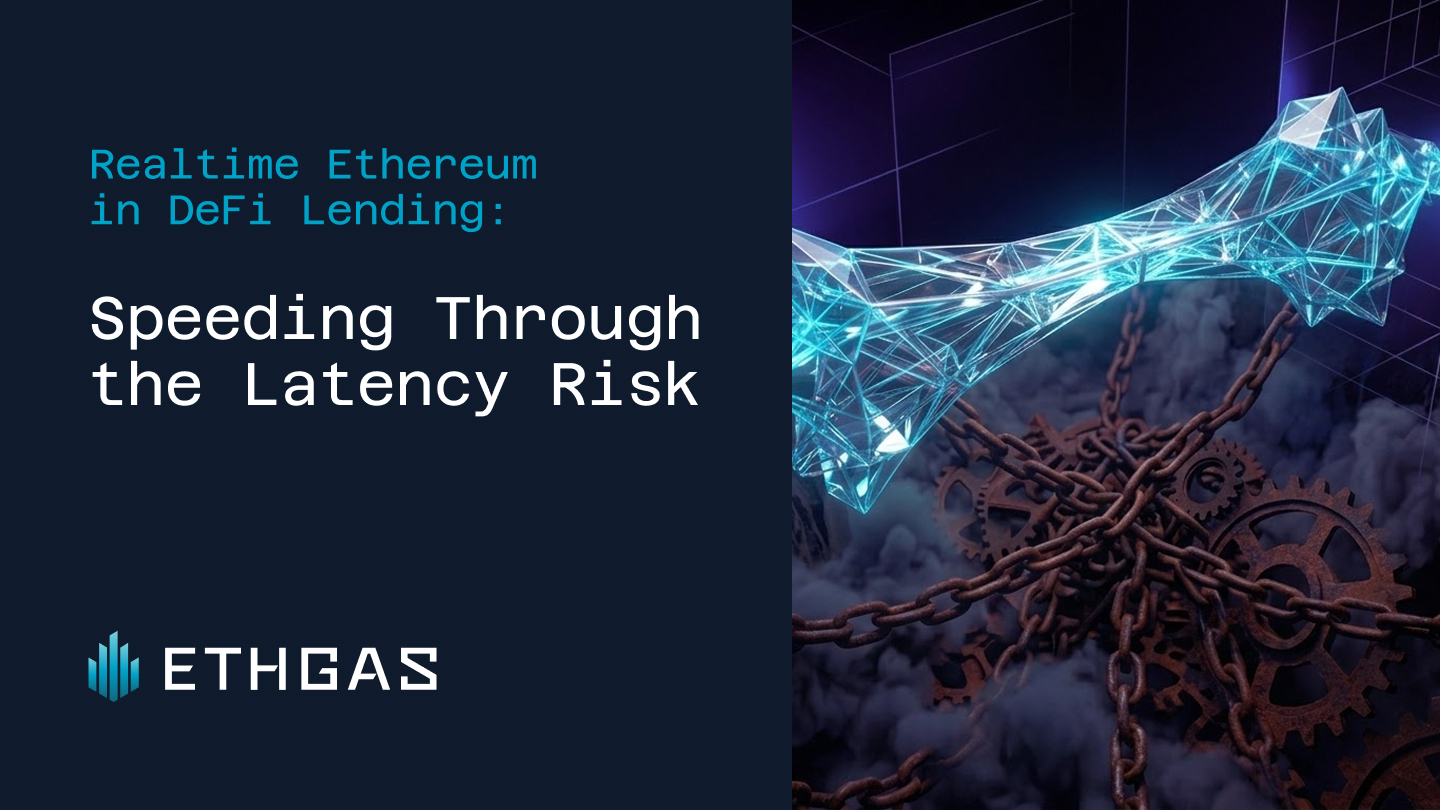
Onchain lending today operates in an environment that forces market participants to be reactive. Liquidations are tied to block intervals, even though price movements occur continuously. This mismatch creates step-function risk events where positions remain stable until they suddenly cross a threshold that triggers dramatic cascades.
The coordination problem between continuous price and discrete liquidation events leaves protocols in a situation where they must size capital buffers around latency risk. Borrowers are also affected because they face cliff-like liquidation dynamics. More so, in volatile conditions, delayed adjustments can amplify losses and create bad debt.
The crux of the problem is that, due to Ethereum’s 12 second intervals, risk management is forced to occur reactively rather than adaptively.
What Realtime Changes
Realtime Ethereum allows both liquidations and risk adjustments to move from binary events to continuous processes. Instead of large, discrete liquidation waves, positions can be gradually rebalanced as conditions change. Smaller and more frequent adjustments reduce cascade risk and create smoother deleveraging cycles.
The fact that collateral can be monitored in real time and margin requirements can adapt dynamically to volatility reduces latency risk. This, in turn, improves capital efficiency which lets protocols reduce excessive buffers and lower borrowing costs. Capital becomes more productive because it no longer needs to compensate for coordination delays.
Instant Settlement for Payments
Current payment solutions still require users to wait for confirmations because blockchains operate with probabilistic settlement. As a result, enterprises must operate under uncertainty about transaction state.
The ambiguity is then passed on to the end-user who catches the friction in checkout flows and operational complexity that neither them or companies experience in traditional payment systems.
What Realtime Ethereum Enables
Realtime Ethereum provides deterministic instant status for payments. Merchant risk is reduced and user experience improved because preconfirmations can be guaranteed and settlement clarity can be achieved in milliseconds. Speed is paired with certainty.
Stablecoins can build on this as a foundation to become truly programmable payment rails. The possibilities extend further up the stack since now high-frequency microtransactions become viable, machine-to-machine payments can execute without waiting for periodic block coordination, and conditional settlement logic can operate continuously rather than discretely.
The Economic Layer of the Realtime Era
Realtime Ethereum transforms trading from periodic to continuous, lending from reactive to adaptive, and payments from fast to truly instant. More than a performance improvement, this creates new roles, new business models, and new fee surfaces. DEXs, lenders, and payment rails are only the first wave that benefits users, enterprises, and protocols alike.
Ethereum’s evolution from a block-based settlement paradigm into a live market infrastructure goes beyond gradual UX improvements and creates a market structure shift. The Realtime Era introduces a new economic layer on Ethereum that’s continuous coordination.
Learn more about Realtime Ethereum and find out how it can benefit you by reading the docs. Follow ETHGas on X to stay in the loop.