The Economics of Instant: An Exploration of Realtime Ethereum
Network latency is the single greatest source of capital inefficiency in DeFi. New data provides the economic case for a Realtime Ethereum, revealing a multi-billion dollar prize for the entire ecosystem.
Ethereum’s 12-second block time is a core design characteristic that prioritizes security and decentralization. While foundational, this latency creates significant economic friction for the DeFi applications built on top of it, imposing a hidden, multi-billion dollar tax on LPs and users.
The concept of a "Lean Ethereum," championed by core researchers like Justin Drake, paints a clear picture of the network's future: faster, more efficient, and economically robust. This vision isn't a distant dream; it's an active engineering pursuit. At ETHGas, we are at the forefront of this movement, building the real-time infrastructure, like Inclusion Preconfirmations, that push beyond the 12-second block time.
In connection with this push toward a realtime environment, a recent discussion paper on the Ethereum Research forum began to explore the economics of instant settlement. Ethereum’s latency represents one of the largest, most under-discussed opportunities in DeFi. While not an exhaustive study, the paper explores this "Latency Tax" and evaluates: what would the economic impact be in a future with real-time settlement?
This article breaks down the data from that research, which reveals two things:
- The immense value is being systematically drained from DeFi due to inherent network latency.
- The staggering economic potential of a future, realtime Ethereum.
The Bleeding Edge: Quantifying DeFi's Toxic Volume Problem
Analysis of key Uniswap v3 pools from June 2025 reveals a stark reality: between 23% and 52% of their volume is toxic arbitrage.
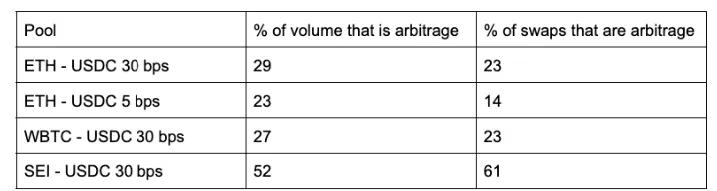
This isn't a flaw in AMM design; it's a direct consequence of the trade-offs in blockchain architecture. The 12-second block time creates a predictable information gap relative to faster, centralized markets. In capital markets, this gap can be exploited with what is known as latency arbitrage. In DeFi, it’s a guaranteed payday for bots at the direct expense of liquidity providers and the ecosystem in general.
The Revenue Revolution: The Data-Driven Case for Speed
The research, in respect of AMMs, doesn't just identify the problem; it quantifies the opportunity that speed unlocks. By simulating the effects of shorter block times, our analysis uncovered two revolutionary findings.
Finding #1: The 30 Bps Fee Model is Sub-Optimal.
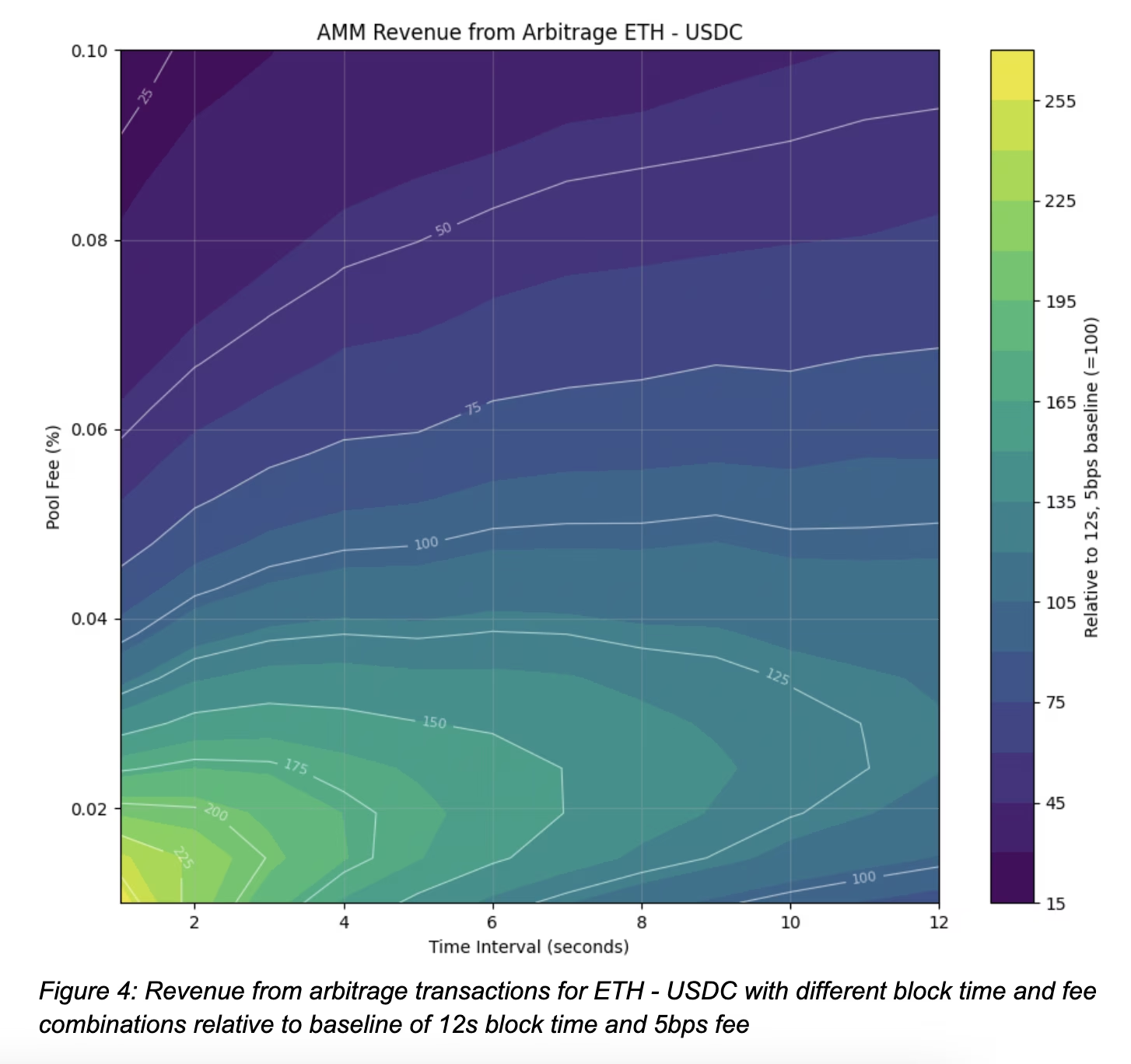
The long-held 30 bps fee often serves as a defense mechanism against latency, not an optimal pricing strategy. The research demonstrates that for protocols to be truly competitive, optimal fees for major assets should be in the 4-11 bps range. This is only possible once the toxic flow is managed, allowing lower fees to attract more organic volume.
Finding #2: Solving for Latency Unlocks Exponential Revenue.
When you mitigate the impact of latency and optimize fees, the revenue uplift is exponential. Our models show a potential 15x revenue increase for the most affected pools. Even for a core pair like ETH-USDC, the potential increase ranges from 60% to over 600%. This isn't an incremental gain; it's a fundamental shift in the DeFi business model.
The Future is Being Built
The research provides a clear, data-backed North Star: a real-time Ethereum is not just an engineering ideal, but the single greatest commercial opportunity for the ecosystem. The 15x revenue potential isn't a projection; it's the economic reality of a frictionless market.
Achieving this future requires a new financial infrastructure layer that can price and deliver blockspace in real-time—a layer that doesn't exist today.
At ETHGas, we are building that foundational layer. Our mission is to engineer the real-time infrastructure that will make this future a reality, turning the latency tax from an unavoidable cost into an optional one.
Here’s how you can get involved:
- For Researchers & Builders: Dive deeper. Read the full paper on ethresear.ch and join the discussion.
- For Everyone: Follow ETHGas on X for more research insights and to follow our journey.